Tag: God

  • Understanding Mark 2:23-28: Breaking Sabbath Rules

    Understanding Mark 2:23-28: Breaking Sabbath Rules

    Mark 2:23-28

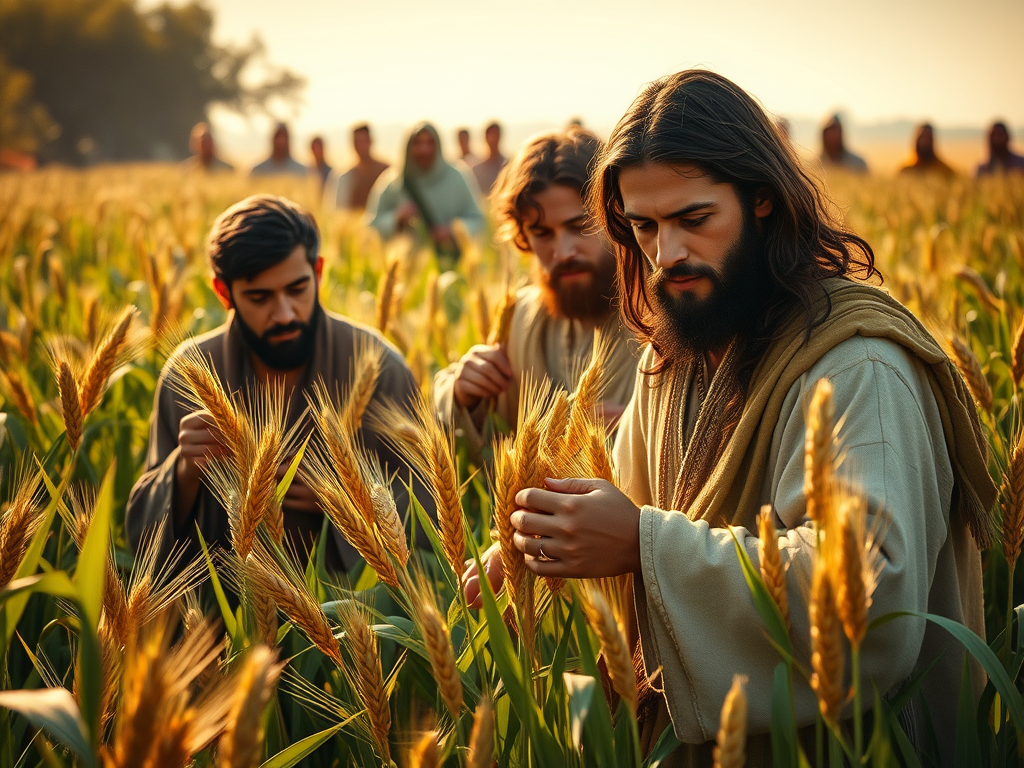
    As Jesus was passing through a field of grain on the sabbath, his disciples began to make a path while picking the heads of grain. At this the Pharisees said to him, “Look, why are they doing what is unlawful on the sabbath?” He (Jesus) said to them, “Have you never read what David did when he was in need and he and his companions were hungry? How he went into the house of God when Abiathar was high priest and ate the bread of offering that only the priest could lawfully eat, and shared it with his companions?” Then he said to them, “The sabbath was made for man, not man for the sabbath. That is why the Son of Man is lord even of the sabbath.”

             Fun Fact:

             The bread of life. 

             Did you know the word Bethlehem means bread? And where was Jesus born? Bethlehem. So, the bread of life was born in a city named bread. Huh.

             In Catholicism, and maybe other religions or branches of Christianity, there is a thing called “Lectio Divina”. It’s basically where you read the same passage three times, and each time you pull something new from it. 

             So, let’s say you read the passage above, and you first focus on the fact that Jesus was walking with his disciples. Disciples and apostles are different things. You might not realize that, I know I didn’t when I first started learning about Christianity. But a disciple is a “student”. Therefore, we are ALL disciples of Christ if we are trying to learn from him. (Rabbi, which Jesus was called, means ‘teacher’.) If you pay attention as you read the gospels, you’ll notice that a LOT of disciples changed their mind about following him. Some left in groups, some stayed. The apostles, the chosen ones, they were set apart from this general group, though they were ALSO disciples. Think of it like a priest is always (hopefully) learning, just like we, the parishioners are always learning (also, hopefully).

    Back to the passage: the disciples here are picking grain. What do we use grain for? To make bread. So, the disciples, on a sabbath (Sunday to us, Saturday to Jewish people of this time) were LEARNING from Jesus on a day they weren’t supposed to be out learning from someone who wasn’t of the main religion running things. Big no-no for religious leaders who want to force control through their religion, I’d say. Or, maybe they were literally just hungry and wanting to make bread. I’m going with the deeper meaning, here. Follow me. 

             On a second run through, you might focus on the fact that Jesus calls out a figure from the Old Testament and basically says, “Hey, this guy you admire did the same thing. He fed his people when they were hungry and he didn’t care what the rules were. In fact he fed them (taught them) the things only the high priests were supposed to eat (know). So, you think that’s okay, but what I’m doing is wrong? Hypocrites.” (I totally paraphrased that.) 

             On the third round, the focus could be on that last bit. “The sabbath was made for man, not man for the sabbath. That is why the Son of Man is lord even of the sabbath.”  Sometimes, it’s okay to break the ‘rules’. This is where being super legalistic and scrupulous (thinking everything you say, do, or think is a mortal sin) comes in. If I see hungry people, and I don’t feed them because a church has a rule against feeding the hungry on a Sunday, am I doing the will of God or man? 

             When I put this all together, I think of how women (I’m a lady, btw) are told to be quiet and meek, humble and holy, and to shut up and listen. We should all shut up a listen, not just women. We should all be meek and humble. What would Jesus think about a woman who has grain, but doesn’t use it to make bread? What if she makes the bread but never feeds it to anyone? What if she is storing her bread for later, but the rats eat it and it goes to waste? What if she’s waiting to make her bread when she has children, but is barren? What if her bread could save her village, but men burn it without using it because they feel it’s the right way of doing God’s will?

             Men and women have different roles, and I find that to be very true. However, I often view religion, the organized kinds, as forcing God’s “will” on others which really just results in a bunch of people standing around pointing out, “Hey, you can’t feed those people! It’s not right! We don’t feed people on the sabbath! Let them go hungry!” 

             Sometimes we have to break the ‘rules’ to be fed or to feed. I don’t mean this in a “women should be priests” way, or that women should be loud and obnoxious. I’m just saying, that after reading this passage about 20 times, that’s the message that kept jumping out at me:

             “Am I scared to discuss my religious beliefs because I feel it’s right to be quiet, or do I keep my mouth shut because other people are telling me I should focus on other things? Do I point out the religious faults in others (to myself) to make myself feel holier than them? Am I living like the faultfinder, or like the almighty?” (Shameless insert of the title to my first novel, there, The Faultfinder and The Almighty.)

             So, my mission for you, disciple, is to read this passage three times and tell me what you find in it. Share your message with others today. Feed people, regardless of the rules. 

             -Amy

  • Daily Pages Volume Two: On Judas Iscariot & Free Will

    Daily Pages Volume Two: On Judas Iscariot & Free Will

             Today marks the day in Holy Week where Judas agreed to rat out Jesus for 30 pieces of silver. I’ve always had a bit of sympathy for Judas in the sense that, if not for him, the passion would have never occurred. He is remembered in history as “evil”, a betrayer of God, greedy, rotten, and to put it bluntly, a crummy friend.       That act of evil HAD to happen. If not for Judas, there would be no resurrection. If not for Judas, Jesus could have been remembered on a similar level to Moses, Elijah, Elisha, and John the Baptist. There was even a person who was in the area Jesus lived right before his time only known as “the Egyptian” who performed miracles, but he didn’t do the one thing that set Jesus apart: none of these others rose from the dead. It is the pillar the Christian faith is built on. So, in a way, shouldn’t we thank Judas? Especially if he had no choice in the matter due to destiny?

             If something is meant to happen, and needs to happen, and Jesus KNEW it was going to happen, it begs the question: did Judas have free will? Or was his fate predetermined for him by the creator, and thus, would an eternal punishment in Hell be fair?

             These are questions I’ve struggled with through the years, and I’ll share where I’m at in finding contentment in that journey. Remember, if you continue to work to grow in your faith and always keep learning and digging for answers when these types of thoughts come to you, your mind might change. So, where you are mentally on a topic like this today, might not be where you are on it years from now. I think the greatest thing we can do for ourselves as followers of Jesus is to always keep learning, because through learning we grow spiritually and can better help others understand our faith, possibly leading them on a new path.

             So, anyway, back to Judas and free will:

             Here is the dumbed down, Amy Pointer version of Free Will. I speak for no one, except for myself here, so don’t go after entire faith systems if you don’t like what I’m about to say. lol

             God is all knowing. God is all powerful. God is the Alpha and the Omega. The beginning and the end. God…is.

             When you are born, God knows every single decision you could possibly make for any possible outcome. God literally created EVERYTHING, right? So, the idea that we ‘dumb’ God down to human abilities or concepts a human brain can comprehend doesn’t make sense to me. 

             There is a theory that currently, there are an infinite number of you’s doing an infinite number of things in an infinite number of worlds. Every small decision you make, from the turn of your head to the choice of car you buy spawns a new world, where that you moves on from there. In those realities, each decision ALSO spawns a new world. 

             This goes on, well, infinitely.

             God works like that theory. He knows every potential choice you will make and the outcome. He knew that there was potential for Judas to make that choice, and he knew it would happen, because he can see all time.

             Think of time not in the sense that we humans look at it. Time is a human construct to help us keep track of things. But “time” isn’t a tangible thing. It isn’t linear. This is why prayer for yourself in the past can work. You can pray for past you, just like you can pray for future you. You can pray for those in purgatory, because time doesn’t exist there, either. 

             Because of all of this, God just “knows”. He knows the potentials, and he knows the outcomes. That doesn’t remove the free will it took for Judas to make that choice. Perhaps when we think of destiny, we shouldn’t think of something that is “meant to be” and think of it as something that just “is”. Your destiny is determined by you, and your choices, no less than Adam and Eve choosing to disobey and seek knowledge of good and evil, no less than Judas choosing to betray his friend who was sent to save the world, and no more than Peter choosing to deny knowing Jesus three times. 

             We are all just one choice away from being a Judas. Don’t discredit his humanity by taking away his choice. He didn’t HAVE to do it, but he did. He wasn’t a predestined robot with a purpose. He wasn’t a secret agent taking whispers from the Lord at the Last Supper with a special mission. (I’m looking at you, Gnostic gospels.) To view it this way takes away from that fact that he was a human man, just like us, and it creates a narrative that makes us look at it and say, “Well, I’d never do that.” 

             Yes, you could. Some of you would. Some of you have. Because, at the end of the day, we are all no greater or worse than the rock he built his church on, Peter; or the one who betrayed him, Judas. We are all Thomas, doubting. We are all Paul, persecuting and condemning, then converting. 

             And the one thing we have that binds us all together in this human journey is choice. 

             Choose wisely. 

    “What are you willing to give me
    if I hand him over to you?”