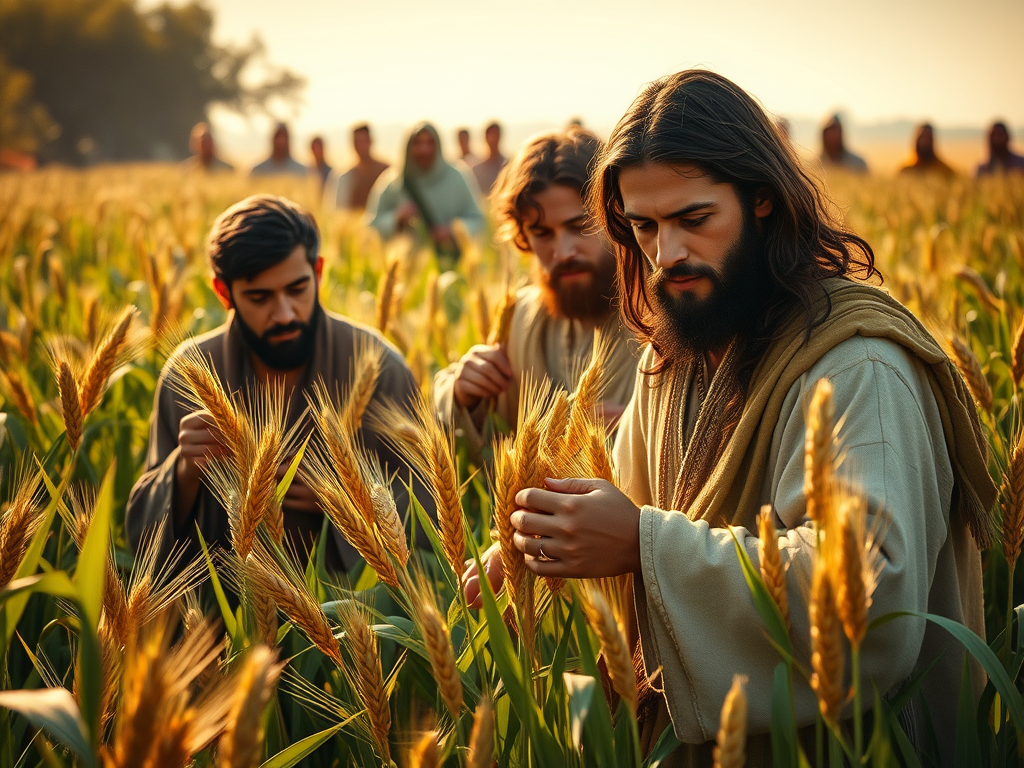
As Jesus was passing through a field of grain on the sabbath, his disciples began to make a path while picking the heads of grain. At this the Pharisees said to him, “Look, why are they doing what is unlawful on the sabbath?” He (Jesus) said to them, “Have you never read what David did when he was in need and he and his companions were hungry? How he went into the house of God when Abiathar was high priest and ate the bread of offering that only the priest could lawfully eat, and shared it with his companions?” Then he said to them, “The sabbath was made for man, not man for the sabbath. That is why the Son of Man is lord even of the sabbath.”
Fun Fact:
The bread of life.
Did you know the word Bethlehem means bread? And where was Jesus born? Bethlehem. So, the bread of life was born in a city named bread. Huh.
In Catholicism, and maybe other religions or branches of Christianity, there is a thing called “Lectio Divina”. It’s basically where you read the same passage three times, and each time you pull something new from it.
So, let’s say you read the passage above, and you first focus on the fact that Jesus was walking with his disciples. Disciples and apostles are different things. You might not realize that, I know I didn’t when I first started learning about Christianity. But a disciple is a “student”. Therefore, we are ALL disciples of Christ if we are trying to learn from him. (Rabbi, which Jesus was called, means ‘teacher’.) If you pay attention as you read the gospels, you’ll notice that a LOT of disciples changed their mind about following him. Some left in groups, some stayed. The apostles, the chosen ones, they were set apart from this general group, though they were ALSO disciples. Think of it like a priest is always (hopefully) learning, just like we, the parishioners are always learning (also, hopefully).
Back to the passage: the disciples here are picking grain. What do we use grain for? To make bread. So, the disciples, on a sabbath (Sunday to us, Saturday to Jewish people of this time) were LEARNING from Jesus on a day they weren’t supposed to be out learning from someone who wasn’t of the main religion running things. Big no-no for religious leaders who want to force control through their religion, I’d say. Or, maybe they were literally just hungry and wanting to make bread. I’m going with the deeper meaning, here. Follow me.
On a second run through, you might focus on the fact that Jesus calls out a figure from the Old Testament and basically says, “Hey, this guy you admire did the same thing. He fed his people when they were hungry and he didn’t care what the rules were. In fact he fed them (taught them) the things only the high priests were supposed to eat (know). So, you think that’s okay, but what I’m doing is wrong? Hypocrites.” (I totally paraphrased that.)
On the third round, the focus could be on that last bit. “The sabbath was made for man, not man for the sabbath. That is why the Son of Man is lord even of the sabbath.” Sometimes, it’s okay to break the ‘rules’. This is where being super legalistic and scrupulous (thinking everything you say, do, or think is a mortal sin) comes in. If I see hungry people, and I don’t feed them because a church has a rule against feeding the hungry on a Sunday, am I doing the will of God or man?
When I put this all together, I think of how women (I’m a lady, btw) are told to be quiet and meek, humble and holy, and to shut up and listen. We should all shut up a listen, not just women. We should all be meek and humble. What would Jesus think about a woman who has grain, but doesn’t use it to make bread? What if she makes the bread but never feeds it to anyone? What if she is storing her bread for later, but the rats eat it and it goes to waste? What if she’s waiting to make her bread when she has children, but is barren? What if her bread could save her village, but men burn it without using it because they feel it’s the right way of doing God’s will?
Men and women have different roles, and I find that to be very true. However, I often view religion, the organized kinds, as forcing God’s “will” on others which really just results in a bunch of people standing around pointing out, “Hey, you can’t feed those people! It’s not right! We don’t feed people on the sabbath! Let them go hungry!”
Sometimes we have to break the ‘rules’ to be fed or to feed. I don’t mean this in a “women should be priests” way, or that women should be loud and obnoxious. I’m just saying, that after reading this passage about 20 times, that’s the message that kept jumping out at me:
“Am I scared to discuss my religious beliefs because I feel it’s right to be quiet, or do I keep my mouth shut because other people are telling me I should focus on other things? Do I point out the religious faults in others (to myself) to make myself feel holier than them? Am I living like the faultfinder, or like the almighty?” (Shameless insert of the title to my first novel, there, The Faultfinder and The Almighty.)
So, my mission for you, disciple, is to read this passage three times and tell me what you find in it. Share your message with others today. Feed people, regardless of the rules.
This year I am creating binders where all three of my kids will have similar information to look through each day. I am using page protectors and will be updating the information weekly/monthly as we retain things.
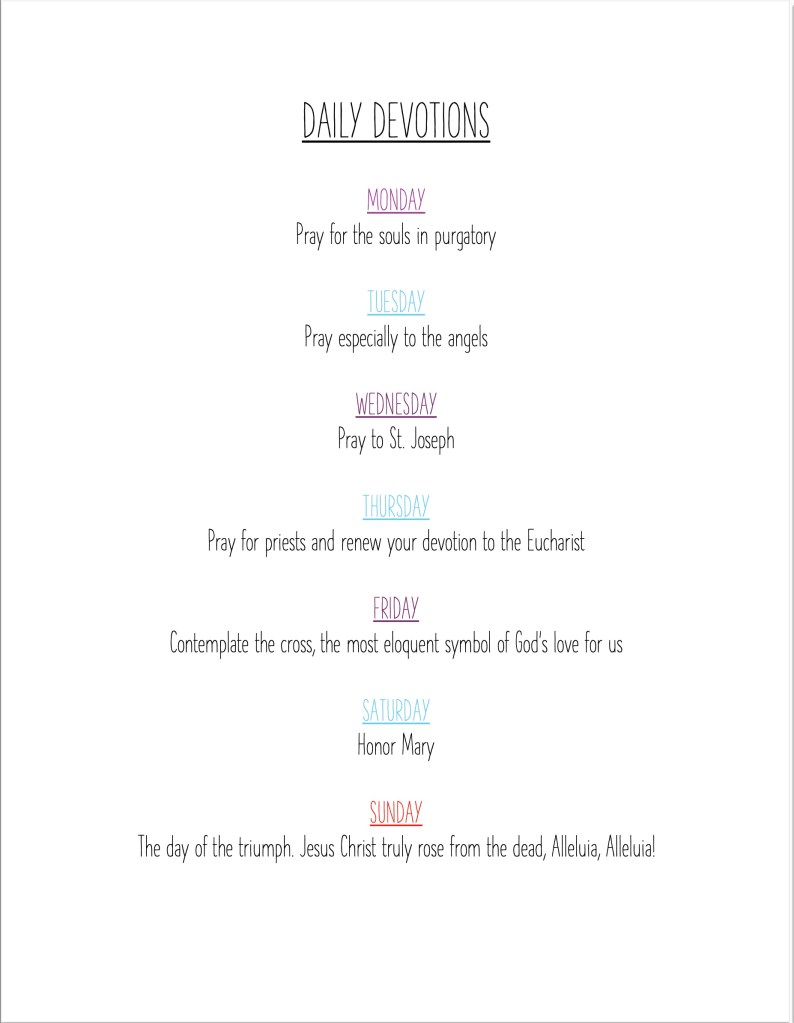
One of the items I am including is this list of daily devotions to help guide us in our prayer. I found this list online, but the printable version took a ton of ink. Homeschool parents, you can understand my struggle with printers and ink, I’m sure! So, I took the info and copied it in an easier to print format. If you would like the original version, I have linked it here. I’m not trying to steal an idea, I’m just trying to save on ink. lol
Here’s the PDF version I made if you would like to print it. Happy homeschooling!
On July 22, 2007, I encountered an angel. I’ve tried to tell this story repeatedly, in various forms, but none of them do it justice. So I’ll try again, and I’ll just speak it like it happened.
A month and a half prior to that day, I’d gone for a routine prenatal visit during my first pregnancy and discovered that the baby had died. I was ten weeks along, but my body didn’t go through the normal process of a miscarriage, so it was labeled a “missed miscarriage.” What followed was a week of pain and misery as I took a medication that was supposed to tell my body what to do and extract the remnants of the pregnancy. Instead, it caused extreme pain, bleeding, and other horrible things I’ll spare you the details of.
Regardless, by July 22, I was still bleeding, still going for blood work multiple times a week to make sure my pregnancy hormone levels were going down, and emotionally, I was still struggling.
My husband was gone. He was in the Army and had left for a training course in another state a few weeks earlier. I was alone in Colorado—we’d just been stationed there after leaving Texas—and other than my new coworkers, I didn’t know anyone. When I woke up that morning, I didn’t think anything was abnormal, since I’d been bleeding all along.
By the afternoon, it was clear something was wrong.
You know in movies when a character says, “She’s hemorrhaging!” and then the person dies? I didn’t know what that meant as a kid, but I found out that day. I had been bleeding profusely for a couple of hours. I didn’t want to bother my husband and worry him if it was nothing, so I drove myself on post and went to the ER. The bleeding was so bad that even with a fresh overnight maxi pad and towels underneath me, by the time I got to the hospital, I had already bled through onto the seat.
I got checked in, and they took me back fairly quickly. They put me in a little room—just a square, gray box. The doctor I saw was young, and he admitted he didn’t know anything about women’s healthcare. He said the OB-GYN wasn’t working that day and wasn’t answering his phone, but he’d try to figure out what was going on.
Hours passed, and I lay in the bed with what I can only describe as a puppy pad underneath me and a thin sheet on top. He said he wanted it that way to “monitor the blood loss.” He did a pelvic exam with the door open, my spread legs facing the entire emergency room. I remember watching a kid with a broken arm on the other side of the ER and saying, “Would someone please shut the door???” but they wouldn’t.
No one seemed to have compassion. No one seemed to care. I lay there, for hours, bleeding out. Occasionally someone would walk in, gruffly grab my face, and yank down on my eyelid. “What are you doing?” I asked. “Making sure you don’t need a blood transfusion,” they said—and walked out.
I cried when they tried to give me the same medication that had started this whole process, remembering how horrible it had been. “I’m just freaking out,” I sobbed. “That medicine made me have to go to the bathroom a lot, and there’s no bathroom in here, and they won’t let me put my pants back on…”
They didn’t care. They simply left the room.
It was late at night. Nobody in my family knew I was there. My cellphone didn’t have any signal to call anyone. I felt like I could die and no one would bat an eye. I looked down at myself—I was soaked in blood from my chest to my knees. Thick, dark red blood. It looked like someone had tried to slice me in half. And that only made it more obvious that no one cared to help me.
It felt like not a single person in the world cared whether I lived or died in that moment. I’ve never felt more unseen.
I wasn’t a Christian. I wasn’t religious. I wasn’t raised in a faith, but I’d been to Sunday school with some friends, and I knew the Lord’s Prayer from hearing people say it in high school. I’d seen The Passion of the Christ. That was the extent of my Jesus knowledge, for better or worse.
For some reason, all I could think about was the part in that movie where Jesus is carrying the cross and falls down. It’s overlaid (or it was in my head at the time) with him as a child running into his mother’s arms. I kept seeing that in my mind as I lay there, bloody and hopeless. And out of nowhere, I had the most random thought.
This is what I was thinking in my head, talking directly to the God I’d always rejected because I hadn’t had any evidence He was real: “It’s okay. It’s okay. If I need to die tonight, it’ll be alright. I’m okay with it.” And I started crying—because I really meant it. I was exhausted in every conceivable way, far beyond just the pregnancy loss and my current condition. I was so tired. I had no other option than to hand it over to God, even if I wasn’t sure He was real or listening. “Your will be done.”
I said it out loud. I said it, and I meant it. It was the only part of the Lord’s Prayer I think I had ever said and truly meant.
At that very moment, the door opened and a woman with big, black, curly hair walked into the room. “I’m here to help you,” she said.
That’s how she greeted me. No “hello.” No introduction. No questions about who I was or what I was there for. Just: “I’m here to help you.”
She inspected me for a second, pulled a big blanket from a cabinet, and unfurled it over me to cover the blood. She grabbed my purse and my clothes and threw them on the bed, then wheeled me out of the room. I remember passing the doctor, who was at a desk on the phone in the center of the ER. He looked confused and said, “What are you doing?” but she ignored him.
She took me to a different room—a bigger one, with a bathroom. She helped me to my feet. I stood before her, naked, and she cleaned every single drop of blood off of me. I just stood there, weak, shaking, and crying. It was the first time I had encountered any compassion in so long. She never even put on gloves. She just knelt before me and cleansed my whole body.
She helped me back into the bed after cleaning it off. “I want you to trust me,” she said. “If you want to get out of here, just do what I say. I’ll stay with you, and it’ll all be alright.”
She gave me some medicine, and I took it. She stayed in the room with me, never leaving.
After about 45 minutes, she asked, “How do you feel?” I felt amazing. I felt like nothing had ever happened. I’d completely stopped bleeding. She smiled. “Do you want to go home?” I told her yes. I wanted nothing more than to get out of there.
She brought the doctor in. He was perplexed—scratching his head and kind of angry. “I don’t understand this,” he said, irritated. “I guess if you feel like you can drive and you want to go home, you can. This doesn’t make any sense.”
She helped me get dressed, and I went home. I didn’t have a single problem after that night.
I’m a logical person. I understand this was all probably just wishful thinking, coincidence, or something that can be rationally explained. But regardless of whether that woman was an angel from Heaven, a gift from God after my total release of will, or just a human nurse with a kind heart, she was an angel to me. She always will be.
When I became Catholic over a decade later, and people asked me why, I gave them truthful reasons. But the spark that started it all was that night. It was that woman. It was that act of compassion—when I felt like the Earth would be fine without me because no one seemed to care about my existence—that started it all. That compassion is why I chose Saint Veronica, the woman who stepped forward and handed Jesus a cloth to wipe his face as he carried the cross while everyone else cheered for his death, as my baptismal saint.
It is easy to be apathetic to those around us, or to go through the motions without thinking our disengagement affects others. But compassion goes a long way, even in small spurts. It can make someone feel like they matter—and for some, it can make them believe you are an angel.
In my novel, The Weeping Key, a modern-day woman named Katie Thorne is transported backward in time by the archangel Raphael to Biblical Galilee to heal her depression following the death of her father. Through interactions with Jesus, his mother, and many others, Katie begins to understand the mysteries of her life and comes to terms with her own suffering.
The journey comes to a conclusion as Katie walks the Stations of the Cross with Mary, (called Miriam in our story to differentiate between the multiple women named Mary), and she watches as Jesus meets his Earthly end.
I formatted this section in my novel by using Mary’s Way of the Cross by Richard Furey. From this perspective, we see the death of Jesus from the eyes of his mother.
I am sharing this entire section of my novel in full today, on Good Friday, in hopes you’ll read it and feel called to learn more about God, Jesus, Mary, the archangels, or anything that makes you question life. I’ve spent most of my marketing of this book going after Christian’s, and I think that was the wrong approach. I didn’t write this book specifically for Christians. I wrote this book for people like me, who question how the actions of others that hurt us can be reconciled with a God of ‘love’. How to feel ‘love’ from God, when you’ve never felt love from your own mother. How to deal with the unknown when a loved one passes and we don’t know where they go, especially when it goes against church teaching.
The Weeping Key was my fictionalized way of stepping into the waters with John the Baptist and other Biblical characters so we could connect to their more human side. I feel like we sometimes read and hear Bible stories, and it’s like watching a cartoon, we see them in 2D, and we hear the stories so much that while we grow fond of the characters, we don’t truly know them like we know our fellow humans who walk the Earth with us now.
These characters were real, they weren’t robots. They had feelings and thoughts, anxieties, and real experiences in life, just like we do. To tear them down into rigid figures does a disservice to the sacrifices they made to become iconic figures still talked about thousands of years later.
My novel doesn’t speak for Christianity, or a particular denomination. My novel is fiction, it’s entertaining, and it was written to plant a seed that might make someone dive deeper into something they don’t know a lot about.
So, having said that, here is “Lully Lulla Lullay”, from The Weeping Key, by Ames Pointer. The name “Lully Lulla Lullay” comes from a song with that title that is a lullaby sang from the perspective of the mothers whose children were killed by Herod when Jesus was born. I could think of nothing more fitting while writing this than to impose the story of those women, who lost their children, over the story of the woman who is losing hers now.
Lully Lulla Lullay
Katie descended into the living space and found herself in between Mary Mary and Miriram. They seemed to be in a standoff, staring at each other in an angry silence that radiated through the air around them and did the speaking for them.
“What’s going on?”
Mary Mary sighed as Miriam looked away from both of them, pushing her chin up in an air of defiance.
“We are going to Jerusalem,” Mary Mary said calmly and kindly. It rose suspicion in Katie, for both the calmness, but especially the kindness.
“I’m not going,” Miriam said firmly, slapping her thighs and gathering her apron in her hands. She began to clean her palms, but they didn’t appear dirty in the first place.
Mary Mary rolled her eyes.
“We’re going,” she said to Katie.
Miriam grunted.
“Is this because of Jesus?” Katie asked, probing for information. After John’s death, the women hadn’t seen him, or Mags and Myra. “Did he come back?”
The women nodded.
“He’s going to Jerusalem for Passover,” Miriam said softly.
It began to dawn on Katie what going to Jerusalem meant. His end was nearing. Katie watched Miriam carefully. Did she know? Miriam looked up at Katie, her eyes pained.
“I don’t want to go,” she said, hoping Katie would listen since her friend would not.
“Then I’ll stay here with you,” Katie responded. Miriam nodded.
Mary Mary wasn’t having it.
“We are going to Jerusalem,” she said in a way that indicated it was going to be the final time she was saying it. “All of us, together, and we are going soon. Now get ready or we’ll end up going alone.”
“I said I’m not going!” Miriam shouted. She had her eyes closed and her fists knotted still holding her skirt. “I don’t want to go!”
“Why?” Mary Mary shouted back, meeting her energy.
“Because,” Miriam shook her head. “Because I don’t want to go.”
Katie took a breath and a pause, unable to decide if she should encourage Miriam to follow her son to his death, which she knew she eventually would, or if she should simply support her in her struggle of emotions. Before she could choose a path of support, Mary Mary surprised her with a thoughtful observation.
“We have to go,” Mary Mary said stepping past Katie and holding Miriam by the shoulders. “You know we have to. It’s time.”
Miriam remained silent but listened to her friend.
“This is what he wants to do,” Mary Mary said. “And I know you are scared. They’re noticing him, he’s making sure of that, and this…”
She hesitated and looked upward, searching for the right words.
“I don’t agree with it,” she said with a huff. “And I wish he’d just come back here and stay put and keep making his sturdy tables, but he’s not going to do that. And I’m afraid if we don’t go with him, we might never see him again. So, Miriam, please. We are going to Jerusalem, and we are going to stay with him until he decides to come home.”
Miriam looked miserable, her eyes full of tears, lips trembling.
“He won’t come home,” she shook her head. “Not here.”
Mary Mary hugged her.
“He’ll come home,” she repeated.
Katie threw herself against the women, arms wrapped around both of them.
“I’ll go wherever you go,” she mumbled. Miriam was stiff as aboard, and her tears were turning into laughter as she fought gravity not to fall over under the weight of the women.
“Fine,” she yelled. “Let go of me!”
“We’re going to Jerusalem?” Katie asked one last time. She looked from one woman to the other. She had a sliver of hope that they weren’t and that the pain that would come with the trip might magically be erased from history if only this one decision were to go differently.
“Yes,” she said finally releasing her apron and smoothing it out. “Yes, we are. And we’re all coming home.”
One way or another, Katie thought to herself.
They followed Jesus into Jerusalem, as close as they could, to a reasonable degree. They followed him as he taught; they traveled with him as he preached, and they walked with him through the gardens. Now, they followed him on the path to his death, and Katie did so with the resolve to stay with his mother, as she had promised.
*
“Crucify him!”
The gyrating mob that lashed out in anger at Jesus threw Katie off balance. He stood beside Pilate at the top of a set of stairs, his chin level, his eyes swollen but focused straight ahead as the hate hurled at him. His body was bruised, bleeding, and beaten. Katie looked for Miriam. She had become separated from Miriam and Mary Mary the instant they had entered the courtyard to head to the sentencing.
“Miriam,” she called. She found her standing near the edge of the crowd, her eyes fixed on her son. Mary Mary stood beside her; her head was bent down as she focused on her feet. At Katie’s call, Mary Mary jerked her head up and motioned for Katie to join them.
“Where have you been?” Mary Mary admonished. “We told you to stay close. It isn’t safe for us here.”
“I’m sorry,” she apologized. “I couldn’t help it. It was like I got stuck in a current. They’re almost…”
“Rabid?” Mary Mary tried to finish.
Katie nodded. She’d expected it. It was just odder than she’d pictured. The frothing rage that wrapped itself around those set to condemn him. It felt…
“Demonic,” Katie said aloud.
Miriam looked at her sharply.
“This isn’t the work of demons. This is them” she motioned to the men who lurked in the crowd with smirks of satisfaction. They were holy men who had worked their way through the hoard, creating a mass hysteria among those gathered. “They don’t care about him, they just care about proving him wrong…”
She broke off and held her chin firm, almost defiant.
“It is what must be,” she sighed, her new mantra to get her through this. Katie had heard Jesus say it the night before. Miriam’s eyes glistened, but she swallowed her tears, pushing forward a front of strength for her son.
“We can stop this,” Mary Mary whispered in her way of thinking she could fix anything. Katie looked at her, and for the briefest moment, wondered if they could.
“No,” Miriam answered as Pilate gave the people a third chance to change their mind from convicting their savior to his death, which they denied. “It must be. He told us so.”
The women no longer questioned or spoke. They watched helplessly as he was pushed away again, this time bound for death.
*
The women made their way to the square, where the crucifixion would start. Two men were dragging heavy wooden beams past them, and as they turned to watch them, a door opened, and Jesus appeared. They threw him down onto the ground. Katie got a closer look at him than she’d had at the trial. He was swollen, a large dark wound on his forehead bled freely down his face, obscuring any other marks that she would have expected from the thorns. His tunic was red from blood, and it fell off his shoulders, revealing flesh torn down into the muscle. She flinched when he tried to rise, as if she could feel his pain, and he met her eyes. She wanted to look away from the gore, but she couldn’t turn away from those brown eyes who had listened to her, and spoke to her so kindly, and who had more compassion than she’d ever experienced before, and she remembered all little black holes in her mind of which he guarded her from. He would want her to watch, so she could remember, even if it was hard. It was his purpose.
The men threw the cross onto his shoulder and he struggled to rise to his feet and carry it, but once he did, they shoved him away and down the path that would lead to Golgotha.
Katie wondered about all the people she knew in her time who spoke of carrying their own crosses. She couldn’t think of her own cross, she could only think of his, and in what ways she’s added to the weight of it. All the times she’d put the weight of the world on her own shoulders, the pain of her mothers challenges, the stress of life, and how she avoided a life with Christ simply out of spite because she thought she could handle it all on her own and that she was too smart, or too intelligent, or that she didn’t need him. She had seen how Miriam worked to lighten it for those around her, and she felt changed, because now she didn’t feel locked in her own head. She wanted to help others carry a cross, like he was doing to the world.
Katie looked at Miriam. Her face was tense, and she held Mary Mary’s hand in such a tight clasp that Mary’s fingers were turning white.
“Miriam,” Katie began, “Peter told us we can take another way. You don’t have to see this.”
Miriam shook her head.
“This is what must be,” she repeated, almost in a daze. “I’m not leaving him.”
And so they walked on silently with the crowd.
*
His tunic was ripped from one shoulder completely. The weight of the wood had dug through his skin and he grunted as he tried to push the cross away from his body. Each lift revealed the yellow and white tissue and bone that was now exposed. He struggled until he fell to the ground and landed straight on his face with the cross landing on his back.
Katie and the women stopped in their tracks. They each held their breath, as did a few that were around them, for they all thought for a moment that he was dead. Miriam began to shake, and Katie and Mary Mary each held her close between them.
The guards kicked him, spitting on him, and yelling at him to rise, and he tried. Ever so slowly, he rose again to his feet, took the cross upon his back again, and received a whip with every step he took, as if no one around him cared he had fallen.
How often had Katie seen people fall around her and not cared? Had she ever watched someone struggle, responding like those around her with no compassion? Like she could ignore it if she pretended she didn’t see it?
“I want to protect him,” Miriam said out of the blue, her eyes wide as she looked at Mary Mary.
“I know,” Mary nodded, placing her forehead against that of her friend.
Miriam took a breath, gathered herself, and they all walked on.
Miriam had broken away from Mary Mary and Katie and had lurched her way through the throng of people lining the streets. She walked with him, each step he took. She took one with him, calling to him through the shouting voices. He stopped for a second and looked at her, his eyes full of pain and confusion.
“Courage,” he said as his mouth dripped with blood. Miriam held her hands to her mouth, trying to hide her horror at what they were doing to her son. She didn’t want him to know how she was aching inside. How it felt like the weight of his pain was on her own soul, so she kept her face as placid as possible. “Courage,” he repeated to his mother, and he walked on.
She paused and waited for her friends, and when they had taken her by both of her arms, together, they followed him.
*
He looked like he was dying right in front of them. Every step seemed shakier. Every breath he took was louder than the previous. Katie wanted it to end. She wished it were over. He stumbled and fell.
The guards were smart enough to know that he needed help and would never make it to the crucifixion if he didn’t have help. They shoved their way through the crowds and came back into the street, dragging a man by the back of his hair. They pushed him down onto his knees beside Jesus, and the man looked up at them in confusion.
“Pick it up,” he prodded the man, smacking the cross with a whip. The man was still apprehensive.
“Why?”
A guard kicked him in the back between his shoulders, and he no longer questioned. He helped Jesus up, and placed the wood on his own back too, easing the load, and together they trudged on.
*
He couldn’t see.
It was bothering Katie that Jesus couldn’t see. The blood from his forehead was mixing with sweat, and it had to be hurting his eyes as it continuously poured the hot, salty liquid into his vision.
“He can’t see,” she said aloud, causing Miriam and Mary Mary to both look at her.
“I know, sweetie,” Miriam answered, doing her best to be motherly, even in her time of extreme grief.
Katie’s own grief was overpowering her.
“He can’t see,” she repeated. “His eyes, there’s so much blood in his eyes…”
Katie felt like she couldn’t breathe.
“This isn’t fair,” she said, looking around above her. Ralph, she thought.
“Where are you?” she asked for Ralph. “This is wrong.”
She let go of Miriam’s arm and stopped. Miriam and Mary Mary looked back at her, and then to Jesus.
“It’s fine,” Katie said breathlessly, motioning to the Lord. “Follow him. I just need a minute.”
She walked in circles, trying to get her lungs to operate properly.
“Where are you?” she asked for Ralph again. “Where are you?”
She was talking to God, too.
“Where are you?” she asked. She felt a wail rising in her stomach and it moved through her chest until it blacked out her senses and she let out an involuntary moan.
She bent over and cried.
“He can’t see,” she whispered. “Isn’t this bad enough? But you must blind him, too?” “It’s so unfair.”
She stiffened upright and wiped her nose and looked around as her breathing normalized to a point she wasn’t so dizzy.
“Well, if you won’t help him, I will,” she muttered to the angels.
She ran into the street and up the path until she reached Jesus and the man from the crowd.
“Wait,” she called. She stopped next to him, hoping the guards wouldn’t whip her, but if they did, she wouldn’t care. “Wait…”
Jesus looked at her as best he could with his swollen, bloody face. She tore her white scarf off of her head and held it to him, carefully cleaning off as much of the blood as she could.
“I’m so sorry they are doing this to you,” she said, holding her crumpled scarf. “I’m sorry.”
She felt a searing pain tear through her back as a guard smacked her with his whip, but she didn’t care. It was minimal to his pain. Jesus turned from her, and carried on, but Katie waited in the road until they carried her off and threw her onto the sidewalk, leaving her lying with her bloody scarf and her tears.
*
Katie ran down the hill, away from everything related to God. She looked up just in time to see Ralph kneeling before her, his arms open wide, his four wings stretched outward. As she collided with him, he embraced her in the warmth of heaven.
“It’s okay,” he whispered into her ear as he clung to her tightly in their cocoon. “It’s okay.”
She shook her head, burying it into his shoulder.
“It’s not okay,” she said. “I don’t want to see this anymore. I don’t want to be here.”
Ralph pushed her off him and held her in front of him.
“Do you want to go home?” he asked.
She thought about Miriam, following her son up to his death, and though she looked brave, Katie knew she was breaking inside. She contemplated how easy it would be for her to say yes and leave this place, and leave these people, because staying wouldn’t change a single thing. She pushed back from Raphael and looked around. In her angelic embraced, resting under the wings of a healer, she saw that the world was full of sparkles.
Katie turned and looked back at the parade of people following Jesus up the hill. The sky above them glittered with spots of light. It looked as if the aurora borealis had fallen to the earth and was undulating over everything. She turned to Ralph, and he smiled.
“This is what I see,” he said softly. “Spirits, of all kinds, are always everywhere.” He closed his eyes and pulled her toward him, pressing his forehead against hers, and when he did, she could see it in a flash: her whole life, chased by the sparkles, consoled by the colors, wrapped in an embrace of spirit in all forms. “This is what we are,” he said to her, “we are always here.” She grasped for words, but didn’t speak them. Her mind followed the lights through her life until they came together into one bright beacon, and then it faded into a white glow. In that glow, she felt Jesus and his mother, and she knew they had always been with her working in the background.
She could leave right now, she thought. She’d seen it all, she’d found love in Miriam and Jesus, she had answers, she knew she had never been alone, and she had what she’d needed to find in this realm, but she couldn’t let it go yet. There was something holding her back from wanting to leave, even though her journey was complete.
It was Miriam.
“I don’t want to leave her,” Katie said tearfully. “Not now. Not yet.”
Ralph nodded, his face full of compassion.
“I know.”
“I have to finish this,” Katie said, taking a deep breath and wiping the tears off her face. “I have to finish this. I need to be here, for her.”
She looked back over her shoulder up the hill, and she could barely see them anymore.
She turned to Ralph.
“I have to go,” she said.
He nodded.
“I’m proud of you, Katie,” he said. She believed him, and she turned and ran, and went to find Miriam and Mary Mary.
*
When Katie reached them, Jesus was on the ground again, this time just shy from the top of the hill. The soldiers were screaming at him and kicking him, as if further abuse would cause him to rise. Miriam and Mary Mary were there, among the others mentioned in scripture, standing near him. The people who had been following the procession were diminishing away. The women stood, hand in hand, watching as the soldiers drug him towards his final destination.
“Katie,” Mary Mary called with no hint of chastisement. She motioned to the other side of Miriam, and Katie instinctively knew she needed her support, so she stood at her side and held Miriam’s arm and hand.
The soldiers pulled Jesus to his feet and ripped off his clothes. Katie turned to Miriam, looking away, but Miriam held firm in her gaze, aimed directly at her son. Katie looked back to him, mirroring the other women. Watching in defiance.
They took him by the arms, both limp, muscles ripped, skin inflamed and broken, and they threw him down onto the cross. He closed his eyes. They tied his arms down. His mouth opened, gasping, as they drove long nails through his wrists. Each bang of the hammer caused the women to jump in unison, and it would have been easy to close their eyes and wait for it to end, but that would be leaving him, so they watched in silence.
They tied his legs, one over the other, and smashed a nail through the bone.
They lifted him up, with the other criminals, hanging them in a row.
He hung in silence for a while, and the women kept their eyes on him the entire time, as if their gaze could bring him comfort. Finally, he looked up with his head shaking, all of his earthly strength going into this final effort, and he looked at his mother. Katie felt Miriam tighten her grip on her arm.
“Woman,” he said, his voice weak and shaking. “Behold your son.”
Miriam nodded to him, her mouth in a firm line and her eyes filled with strength. Katie heard her whisper, in the faintest of tones, ‘my son’.
He looked over at the others, his eyes stopping on Katie.
“Behold,” he said, seemingly speaking to her. “Your mother.”
Katie understood. She finally understood love. She looked at Miriam and thought of all the ways she had supported her and blessed her, and how she wanted to give that back to her in any way she could. Love wasn’t about filling a set role given to you by birth. Love was a choice. A choice that had to be made every moment, of every day, to forgive and to support, to learn from and to teach, to meet people where they are and not for what you want them to be, and to be there, no matter what. Katie loved Miriam, but more so, she allowed herself to be loved by her.
He looked up at the sky.
“I thirst,” he choked. A soldier took a sponge, stabbed it to the end of a spear, and held it up to Jesus’ mouth. When he had received it, he sighed.
“It is finished,” he said with relief. He closed his eyes, and he quietly died, alone on a cross, with his mother watching from below.
*
Everyone was gone. The noise from earlier in the day was now silence. His mother and his friends stood quietly near him and looked up at his dead body.
Two men took him from the cross, and Miriam broke free of the grasp of Mary Mary and Katie and went to him, taking him into her arms. She held him in her lap like a child. She inspected his face, ran her hands over his bloody wounds, and finally, she wept. She cried, a tear for each piece of torn flesh.
“It must be,” she said to him, tracing the turn of his nose with her finger. “It must be,” she repeated as she placed her finger on his lips.
Katie wanted to lunge forward and comfort her, but Mary Mary stopped her.
“No,” she said, crying. “Let her be.”
Miriam pulled him to her chest, his arms falling down behind him, and she cried, covered in his blood. Everyone stood still, weeping. They let her grieve and simultaneously praise the Lord. Miriam praised him, even in her pain, because she knew it was needed to fulfill all that had been promised in the old times before, even if it hurt her almost more than she could bear.
When she had calmed, she looked up to his friends, and they took him to the tomb that had been arranged, and she came back to Mary Mary and Katie.
“Miriam,” Mary Mary began. Miriam stopped her and hugged her, leaving a streak of her son’s blood on Mary’s cheek.
“It is finished,” Miriam whispered. “It is over. Help them.”
Mary Mary went to work, in her way of showing love, guiding the men and women on what they needed to do. Miriam turned to Katie, who stood alone in the same spot she’d been in for hours.
Miriam embraced her, holding her tightly to her chest. Katie felt Miriam’s face dig into her neck as she kissed her cheek through her exposed, rumpled hair.
“I didn’t want to leave you,” Katie said as she hugged her back.
“I know,” Miriam said. She held Katie by the shoulders and searched Katie’s face with her eyes. She pulled her closer and held her forehead against Katie’s, leaving a patch of Christ’s blood. Katie began to cry. She’d tried so hard to keep it in, and to be strong for Miriam, but she couldn’t do it any longer. She mourned for her, and with her.
“Thank you,” Miriam whispered to Katie. “Thank you for staying with me. I’ll always be with you. I promise.”
Katie nodded through her tears.
“It is finished,” Miriam said, kissing her Katie on the forehead. “It is finished.”
Today marks the day in Holy Week where Judas agreed to rat out Jesus for 30 pieces of silver. I’ve always had a bit of sympathy for Judas in the sense that, if not for him, the passion would have never occurred. He is remembered in history as “evil”, a betrayer of God, greedy, rotten, and to put it bluntly, a crummy friend. That act of evil HAD to happen. If not for Judas, there would be no resurrection. If not for Judas, Jesus could have been remembered on a similar level to Moses, Elijah, Elisha, and John the Baptist. There was even a person who was in the area Jesus lived right before his time only known as “the Egyptian” who performed miracles, but he didn’t do the one thing that set Jesus apart: none of these others rose from the dead. It is the pillar the Christian faith is built on. So, in a way, shouldn’t we thank Judas? Especially if he had no choice in the matter due to destiny?
If something is meant to happen, and needs to happen, and Jesus KNEW it was going to happen, it begs the question: did Judas have free will? Or was his fate predetermined for him by the creator, and thus, would an eternal punishment in Hell be fair?
These are questions I’ve struggled with through the years, and I’ll share where I’m at in finding contentment in that journey. Remember, if you continue to work to grow in your faith and always keep learning and digging for answers when these types of thoughts come to you, your mind might change. So, where you are mentally on a topic like this today, might not be where you are on it years from now. I think the greatest thing we can do for ourselves as followers of Jesus is to always keep learning, because through learning we grow spiritually and can better help others understand our faith, possibly leading them on a new path.
So, anyway, back to Judas and free will:
Here is the dumbed down, Amy Pointer version of Free Will. I speak for no one, except for myself here, so don’t go after entire faith systems if you don’t like what I’m about to say. lol
God is all knowing. God is all powerful. God is the Alpha and the Omega. The beginning and the end. God…is.
When you are born, God knows every single decision you could possibly make for any possible outcome. God literally created EVERYTHING, right? So, the idea that we ‘dumb’ God down to human abilities or concepts a human brain can comprehend doesn’t make sense to me.
There is a theory that currently, there are an infinite number of you’s doing an infinite number of things in an infinite number of worlds. Every small decision you make, from the turn of your head to the choice of car you buy spawns a new world, where that you moves on from there. In those realities, each decision ALSO spawns a new world.
This goes on, well, infinitely.
God works like that theory. He knows every potential choice you will make and the outcome. He knew that there was potential for Judas to make that choice, and he knew it would happen, because he can see all time.
Think of time not in the sense that we humans look at it. Time is a human construct to help us keep track of things. But “time” isn’t a tangible thing. It isn’t linear. This is why prayer for yourself in the past can work. You can pray for past you, just like you can pray for future you. You can pray for those in purgatory, because time doesn’t exist there, either.
Because of all of this, God just “knows”. He knows the potentials, and he knows the outcomes. That doesn’t remove the free will it took for Judas to make that choice. Perhaps when we think of destiny, we shouldn’t think of something that is “meant to be” and think of it as something that just “is”. Your destiny is determined by you, and your choices, no less than Adam and Eve choosing to disobey and seek knowledge of good and evil, no less than Judas choosing to betray his friend who was sent to save the world, and no more than Peter choosing to deny knowing Jesus three times.
We are all just one choice away from being a Judas. Don’t discredit his humanity by taking away his choice. He didn’t HAVE to do it, but he did. He wasn’t a predestined robot with a purpose. He wasn’t a secret agent taking whispers from the Lord at the Last Supper with a special mission. (I’m looking at you, Gnostic gospels.) To view it this way takes away from that fact that he was a human man, just like us, and it creates a narrative that makes us look at it and say, “Well, I’d never do that.”
Yes, you could. Some of you would. Some of you have. Because, at the end of the day, we are all no greater or worse than the rock he built his church on, Peter; or the one who betrayed him, Judas. We are all Thomas, doubting. We are all Paul, persecuting and condemning, then converting.
And the one thing we have that binds us all together in this human journey is choice.
Choose wisely.
“What are you willing to give me if I hand him over to you?”
In an effort to get through the book “The Artists Way“, I will be posting my daily pages (journal like entries) to this blog.
Daily Pages Day 1:
I’ve never been good at “Lent“. I feel like I end up in my own personal desert, year after year, feeling farther away from God for those 40 days of sacrifice rather than closer to him.
It isn’t because I’ve “given something up” and I’m weak at self-control at all. It’s just, year after year, I feel a distance between the Lord and I in what should be the season where I’m working to feel closer to Him, and I get mad about it and lose the point of it all.
All of the liturgies, the chances for prayer, the sacrifices, almsgiving, and more don’t reel me into a deeper spiritual life. I feel a lacking, like a pulling away from God during this time. I feel myself yearning to be closer to Him, wanting to find ways to feel his presence in my daily life, and coming up short every time. It’s like, the harder I try to get a deeper connection, the more He pulls away.
This has to say more about me psychologically than it does about God during this time. I’ve spent a lot of time reflecting on what this could mean on a personal level, to try to connect but feel more disconnected. To want to be in community with others, but to feel lonelier. To want to be seen, and to share your gifts, but to feel invisible.
I think it all boils down to contentment.
That’s probably not where you thought I was gonna go with that one. I bet you expected this to turn into a psychological breakdown of childhood trauma or something about spiritual warfare, or some other deep matter.
However, after much thought, I think it’s about being content with where you are and what you have.
I want to feel closer to God. To have the spiritual awakening, the supernatural connection to the divine that many Saints we know and love experienced. I want my divine revelation. I want my visions. I want to see angels. I want to feel Jesus with me, all the time. I want to hear God speak to me, to tell me something that I can use to help humanity. I want, I want, I want…
But… do I even use what I already have? Do I already go to the greatest lengths possible to pursue my faith life, or do I phone it in some days and put off reading my Bible, or saying I’m too tired to pray a rosary, or thinking novenas are too hard for a person like me to stick to for nine days???
I need to be content with the God I have, and not the God I want. The God I have is already great.
I want to be a Saint, but I don’t want to suffer.
I want help others, but I put myself first.
I want to speak for God, but I don’t listen to Him all the time.
I want to be an Apostle, but I don’t give my best effort to being a disciple.
I want to skip all the hard stuff and reap all the glory. I want the Jesus who came after the desert, but I don’t want to walk with him in it.
And so, it all comes down to being content. With who I am, with what I am, with where I am, and with what will be.
I may not like walking in the desert, feeling far from God, on what feels like a parallel journey with Jesus with a giant canyon between us, but it’s what I need to do so I can see my faults and learn how to do better, be better, and then, after that dark, lonely journey, maybe I’ll be able to feel God more closely.
Sometimes, to enjoy the embrace of a loved one, we have to go without it for a while to appreciate it. So, I guess I get more out of my unsuccessful Lents than I realized.
“My grace is sufficient for you,
for my power is made perfect in weakness.”
I will all the more gladly boast of my weaknesses,
Jesus departed from there and came to his native place, accompanied by his disciples. When the sabbath came he began to teach in the synagogue, and many who heard him were astonished. They said, “Where did this man get all this? What kind of wisdom has been given him? What mighty deeds are wrought by his hands! Is he not the carpenter, the son of Mary, and the brother of James and Joseph and Judas and Simon? And are not his sisters here with us?” And they took offense at him. Jesus said to them, “A prophet is not without honor except in his native place and among his own kin and in his own house.” So he was not able to perform any mighty deed there, apart from curing a few sick people by laying his hands on them. He was amazed at their lack of faith.
Mark 6:1-6
I remember coming across a post on social media many years ago from a man who was trying to get a coffee shop off the ground in his hometown. He was upset, and he claimed that the people who should be supporting him the most: his friends, family, community, and church, were all letting him down because he wasn’t getting the support he expected he would get.
I think of that man often when I see people upset about not having the support of their closest people when they are trying something new in life. Often, it’s said, that the people who don’t know you will support you far more than the people in your inner circle.
I have found that to be true at times in my life, but I’ve also encountered a lot more support than I ever expected at other times. It varies, honestly.
Jesus had this problem, but on a larger scale. Can you imagine walking around performing miracles, healing people, spreading a message of love and acceptance as people claimed you were God, and yet those in your social circles and community didn’t believe it?
That is what today’s gospel reading brings us. Jesus is back home, hanging out with his friends and family and he starts doing his usual teaching.
(Side note: Notice when the Bible uses the word disciple and when it uses apostle. Did you know there’s a difference in those two things? I thought they were the same thing, honestly. However, they are different. See, disciple means “student”. So, by that definition, we are ALL disciples of Christ. Where as apostle was specifically the twelve. Rabbi, which Jesus is often called, means teacher. So, teacher to the students: rabbi-disciple. Anyhoo, I had to throw that in here.)
So, back to JC. He’s teaching in his own little neighborhood, and the people who he was raised with are all like, “Who does this guy think he is? Isn’t this Mary and Joe’s son? Isn’t this the guy we’ve always known and hung out with?” They seem appalled that he’s spitting all of this new wisdom at them, and they aren’t having it. They are actually offended by what he is saying and doing, rather than being proud of him and honoring and accepting him.
I’m sure it was hurtful to Jesus to not have those people believe in him. Maybe the thing we can take from this specific reading is this: support those around you, even when what they are doing isn’t exactly popular or in alignment with what you expect of them. A gentle pat on the back to someone trying something new can be extremely encouraging. A little like or love on social media, a swing by a local coffee shop or store, an encouraging word to someone trying out a new ministry at church, telling that new lector they are doing a good job, or even giving a frazzled parent who has chased their child around the church during Mass a smile and telling them you are glad to see them AND their kids can make a world of difference.
Little acts of kindness can change the world. We can’t expect a magical blanket of world peace to fall upon us if we aren’t able to recognize the divinity in our neighbors and extend even the smallest bits of love their way.
Don’t just accept Jesus, accept your neighbor, and love them both. (& their coffee shops. lol)
THAT can bring peace to our world, and to our souls.
I’ve been reading a book I found at the library on apocrypha. (Biblical or related writings not forming part of the accepted canon of Scripture-Google dictionary.)
None of these stories claim to be true, nor are they meant to be read that way, but it’s still fun to look at writings that tell these stories which were passed orally for long periods of time.
While the three pieces about his birth were very interesting, so far my favorite section pertains to the childhood of Jesus. I’m going to paraphrase some highlights, many of which I’d read before but there were a few things that were new to me. I’m going to put them in my own words, combining the three passages into one cohesive story about a realistic portrayal of the God side of Jesus clashing with the very human child side.
So, let’s start when Jesus was about five years old. In these readings, Jesus is a ‘holy’ terror. On one particular Sabbath, which is a day that as a Jewish person he wasn’t supposed to be doing much, he sits beside a creek making clay birds. A fellow child sees him doing this, and goes and gets some adults because he knows the rules about keeping the Sabbath holy.
Joseph and some other adults show up, and Jospeh chastises Jesus for doing this on a day he knows he not supposed to be doing it.
Jesus immediately cops an attitude about being told what to do, as he knows he’s God AND human. He claps his hands and the birds fly away. Yes, you read that correctly, the birds made of mud turn into real birds and fly off.
The other child, the one who ratted him out, makes a kerfuffle about it, and Jesus withers him like he withered the fig tree as an adult. Literally. He kills the kid on the spot. He’s like, “I’m God and all knowing, don’t tell me what to do!”
Now, the adults are all freaking out. They ban together and have a meeting in the village and they confront Jospeh and tell him, “Hey, Joe, your kid can’t be killing our kids like this.” (It is written like this, which makes me think this wasn’t the first child the Lord had off’d impulsively.) They tell him that if he can’t control his child, he’s going to have to find somewhere else to live.
Jospeh goes home and tells Jesus what is going on. Jesus doesn’t take it well. He thinks they shouldn’t be trying to control him, and that he’s more knowing than they are (just like a five year old) and he BLINDS EVERYONE WHO WAS AT THE MEETING.
Joseph and Mary eventually talk some sense into the child, and he does restore everyone’s vision and brings the withered child back to life. From here, a man decides Joseph and Mary need help raising this kid, so he offers to be Jesus’s teacher.
Jesus isn’t a very receptive student. He spends most of his first lesson speaking in parables and educating the teacher about life, mirroring much of the story of his sitting in the temple teaching the grown men when he is twelve. In this case, the teacher tries to bring it down to a simple level: let’s start with the ABC’s.
Jesus takes the letter A (in his language) and manages to teach a parable about the Holy Trinity. He says, “See how there are two marks parallel on the sides, and a slash that goes through the middle. Three pieces form one single letter, working individually and equally to form one letter.”
The teacher has had it by the end of day one. He’s like, “Joseph, this child is God, and there’s nothing I can teach him. I don’t know what to tell ya, big guy.”
By the time he’s six, he’s seemed to calm down a little bit, but his troubles still exist. He’s playing on a roof one day with some friends, and a kid falls off the roof and dies. It isn’t Jesuses fault, but everyone on the ground who finds the kid thinks Jesus did it. Jesus jumps off the roof and gets angry. He’s all like, “How dare you accuse me of doing the things I’ve been doing! But this time I really didn’t do it!”
Basically, in an effort to prove them all wrong, he resurrects the kid in front of everyone, and all who witness this, along with a little speech shaming them for doubting him even though he’s been known to do those exact things before, they all then believe and worship him.
That’s as far as I’ve gotten so far in my little journey with kid Jesus. I find the portrayal to be highly plausible. Yes, I know he’s sinless and perfect and all of that. But you have to admit, the idea of a child taking a little while to grow into his God powers and to learn how not to just wipe out humanity out of irritation seems like it could be true. lol (I’m looking at you, flood story.)
Would anyone be interested in reading more of my write up’s of this book? I’m loving it so far, and I am enjoying putting my own little comedic spin on the stories. I love Jesus. I also think I love little fictional murderous Jesus a bit, too.





 Nicheless Wonder, A Blog by Ames Pointer